What Size Should You Print Your Wall Art? A Complete Size Guide
Standard Print Sizes and What They’re Best For
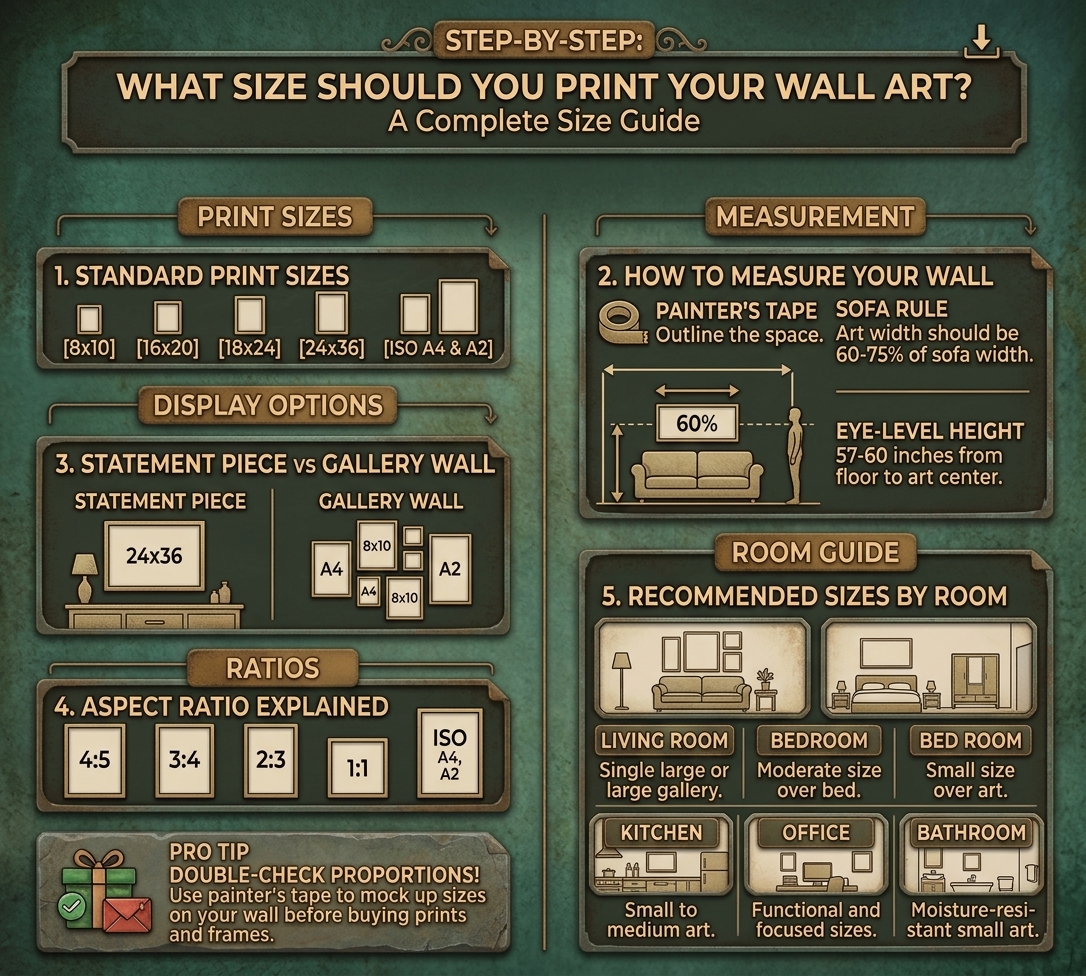
Most wall art comes in a handful of standard sizes, and each one suits a different job. Knowing them helps you serve the people who’ll live with your choices.
- Choose 8×10 for tabletop frames. It’s a classic, and it gives a desk or shelf a personal touch. Pick 16×20 when you’re displaying a standard portrait photograph.
- Select 18×24 for accent walls and gallery walls. Budget-friendly retail frames are easy to find in this size, so you can outfit a room without overspending.
- Go with 24×36 when you want a statement piece. This movie-poster standard anchors a couch or bed as a focal point.
- For your international clients, offer A4 for small desk frames, or A2 for clean, modern, Scandinavian-style spaces that need sleek proportions.
How to Measure Your Wall Before Choosing a Size?
A roll of painter’s tape is the best measuring tool you own. Use it to outline your intended frame size on the wall before you commit to a print.
Above furniture, measure the exact width of your sofa, bed, or console table. Multiply that number by 0.66 and 0.75. For a 72-inch sofa, you’ll want art between 48 and 54 inches wide. If you’re hanging several pieces, include the frames and the gaps between them.
For an empty wall, measure the bare width and cover about six-tenths to three-quarters of it. Leave 6 to 8 inches of blank wall on each side so the space welcomes everyone who gathers there.
Center art 57 to 60 inches high; above furniture, leave 3 to 6 inches.
Sizing for a Single Statement Piece vs. a Gallery Wall
Two approaches work for most walls: one large anchor piece or a cluster of smaller prints, and each calls for a different sizing method.
For a statement piece, choose art spanning 50% to 75% of the furniture’s width below it. You’ll center it at eye level, about 57 to 58 inches from the floor, or hang it 6 to 12 inches above a sofa or console. Prints from 24×36 to 36×48 inches create a clutter-free focal point.
For a gallery wall, mix sizes like A3, A2, and 8×10 to build balanced asymmetry or a tidy grid. Leave 2 to 3 inches between frames. It suits hallways and staircases, welcoming guests. Map the layout on the floor or tape kraft paper templates to the wall.
Aspect Ratio Explained (Why Not All Sizes Work for Every File)
Every image has a shape, and that shape is its aspect ratio: the proportional relationship between width and height. It describes form, not physical size.
Not every print size suits every file. If you force a file into a different ratio, you’ll get cropping, stretching, or awkward white borders. A 4×6 photo (2:3) in an 8×10 frame (4:5) loses its edges.
Match your file to these common ratios: 4:5 (8×10, 16×20, 24×30), 3:4 (12×16, 18×24), 2:3 (8×12, 12×18, 16×24, 24×36), and 1:1 for squares. ISO A-series sizes share a 1:√2 proportion.
To check a fit, divide the long side by the short side for both your file and your print size. If the results match, the size works. Confirm your client’s dimensions before ordering.
Quick Reference: Recommended Sizes by Room
Once your file’s ratio fits, the next question is how big to print it, and that depends on the room. Use these sizes to create spaces that welcome the people you serve.
- Entryway: Hang an A1 or A0 piece on a wide facing wall to greet visitors. In narrow hallways, stack A4 or A3 prints vertically.
- Above the sofa: Choose art spanning 60–75% of the sofa’s width, such as an A1 or A0 single piece.
- Bedroom: Pick A2 or A1 above the bed, depending on its width. Use A3 or A2 above a desk.
- Kitchen nook and bathroom: Select A4 or A3. In bathrooms, use glazed or sealed frames so humidity won’t harm the print.
- Center each piece at 145–155 cm from the floor.